

Breaking Stories Apart
A platta is, in practical terms, a list of the actions or events that make up a performance. It can be a map, a recipe, a menu or simply a sequence of things that happen.
I came across the term while reading a book about Shakespeare and the theatre of his time. Backstage, performers would have a list of the scenes to be played, showing them what was coming next. For example, a scene from Hamlet might be described simply as: “The King and Laertes plot their revenge on Hamlet.”
The performers could look at the list and know what came next.
I liked this idea because I was already interested in taking stories apart. Rather than treating a story as a continuous, predetermined sequence, I wanted to examine its individual components. What happens when you separate the pieces? What happens when you change their order? What happens when you remove some, repeat others, or place things together that don’t seem to belong?
I began making lists of the different elements that make up stories. I treated those elements as modules — pieces that could be moved, combined, multiplied or removed.
Each new arrangement created different relationships between the parts. The same material could produce something entirely different depending on how it was organized.
It felt like working with the pieces of a universe and creating new universes depending on where those pieces landed.
Moving Between Worlds
Working with Plattas reminded me of changing television channels or surfing the internet.
One click and you’re somewhere else. Another click and you’ve entered a completely different world. Things that have no obvious relationship to one another suddenly find themselves side by side in our minds.
I was interested in those leaps.
When we move from one website to another, we don’t necessarily follow a continuous story. We move between fragments of countless stories. We encounter different people, places, events, arguments and images, often without any transition.
And yet our minds are continually trying to connect them.
I wanted to explore what happens when theatre works this way.
There is a relationship here to Brecht’s alienation effect, but accelerated. Instead of allowing the audience to settle comfortably into a single unfolding narrative, the structure repeatedly shifts their attention and asks them to make new connections.
The story is no longer one story. It becomes a series of passages between different worlds, with countless possible relationships between them.
But something happens when we experience stories this way.
We can begin to feel isolated and alone, as though the structures that once connected everything have disappeared.
The familiar glue is no longer there.
What Holds Everything Together?
This became one of the most important questions in my work.
If a performance is no longer held together by conventional storytelling, what takes its place?
There is something that holds the moments together, but it is less defined and extremely powerful.
I think of it as a kind of glue.
When working with a group of performers, this underlying connection becomes essential. We can no longer depend on a familiar narrative structure to carry everyone from one moment to the next. The performers need to discover something else that connects them to one another, to the material and to the audience.
This is often where I put most of my attention.
The work is not simply about rearranging scenes or experimenting with unusual structures. It is about discovering what can hold a performance together when the expected structures are no longer there.
I have spent a great deal of time working with this question, and I hope to write more about it.
Challenging the Structures of Storytelling
When I first started working this way, I encountered considerable resistance.
Not lining up a story “properly” could make people angry. To some, particularly those deeply invested in established theatrical structures, what I was doing seemed completely mad.
But I began to understand that challenging the structure of a story could feel like challenging much more than a theatrical convention.
Stories organize how we understand ourselves and the world. We identify with particular ways of telling them. Those structures can become so familiar that we stop seeing them as structures at all.
When someone begins to take them apart, it can feel like a direct affront to the ego, particularly when our sense of identity or authority is tied to a particular way of understanding things.
There is power in the way stories are organized. There is also power in deciding which stories can be told and how they must be told.
Changing their structure can challenge that power.
For me, working this way was a revolutionary act.
But this also meant that the relationships between the people creating the work became even more important.
Change can produce fear, confusion and resistance. When the familiar structures disappear, the group needs something strong enough to withstand that uncertainty.
That is why the underlying energy connecting the performers matters so much. It is something we must continually work on, because it is what allows us to take risks together.
Plattas in Practice: 7 Important Things
The creation of 7 Important Things, developed in collaboration with George Acheson and directed by Nadia Ross, provides an example of how I used this approach.
The production tells the story of George’s life, but it does not follow the conventions of a straightforward biography.
Instead, it moves between different kinds of theatrical material: personal stories, reenactments, songs, projected images and live discussions.
The script identifies these elements as separate components, including True Stories, Plays, Songs and Discussions.
Some of the discussions are timed rather than scripted. George and I could move away from the proposed subject and discuss whatever seemed important in that particular moment. The structure was established, but what happened inside parts of it remained open.
The different elements could create unexpected relationships between George’s personal history and larger questions about society, freedom, capitalism, rebellion and belonging.
The Platta helped organize the different parts into a performance while allowing each element to retain its own character.
Rather than relying entirely on a continuous narrative, the production asked audiences to make connections between the pieces.
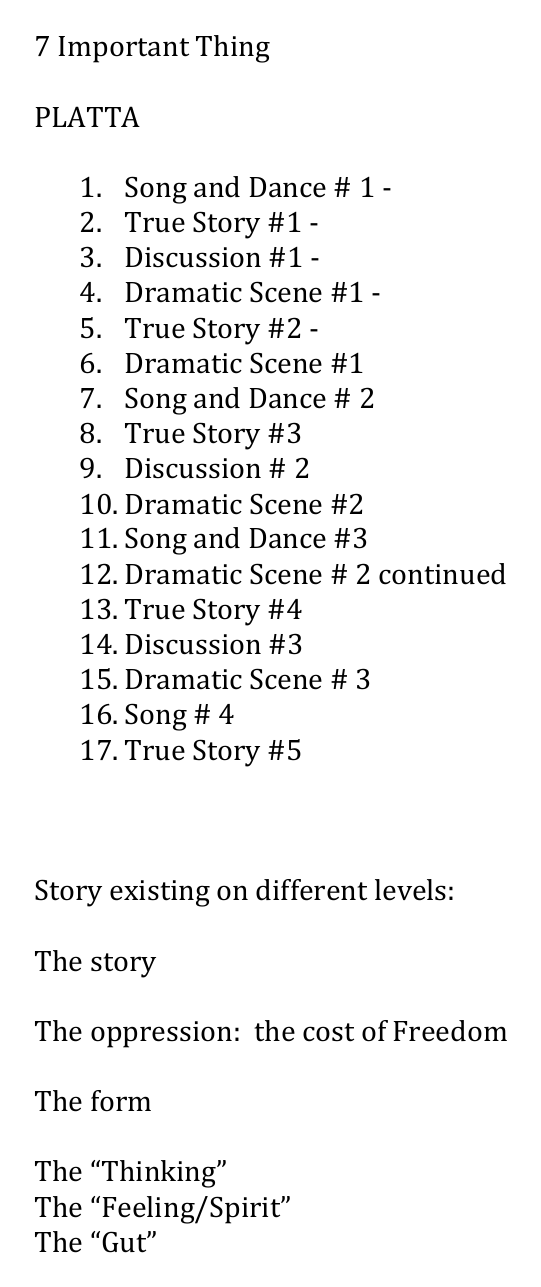
The Platta for 7 Important Things identifies seventeen separate components, including songs, true stories, discussions and dramatic scenes. It also identifies several levels on which the work operates: the story itself, oppression and the cost of freedom, theatrical form, thinking, feeling and spirit, and the gut. These layers are not necessarily expressed through a continuous narrative. They exist alongside one another, creating relationships between the different elements of the performance.
The Platta : an example
7 Important Things — Platta
The original Platta illustrates the structure of the production and the different levels on which the story operates.
Read the Script
7 Important Things (2007–2015)
Created in collaboration by Nadia Ross and George Acheson
Directed by Nadia Ross
31 pages | English
The script offers an opportunity to examine the structure of the production, including the relationship between scripted scenes and unscripted discussions.
Read the script of 7 Important Things →
Copyright © STO Union. The script is provided for reading, research and educational purposes. Permission to workshop or produce the play must be obtained from the rights holders and STO Union before any public presentation. Royalties may apply.
Related Production
7 Important Things (2007–2015) — Theatre
Learn more about the original theatrical production, its artistic collaborators, international touring history and critical reception.
Explore 7 Important Things →
Watch the Performance Video
7 Important Things — Performance Video (2021)
In 2021, Nadia Ross created a 65-minute video from archival recordings of 7 Important Things made during its international tours between 2007 and 2015.
The video brings together different performances of the same work, offering an opportunity to experience how the theatrical structure functions onstage.
Watch 7 Important Things — Performance Video →